In-App Notification System
Every important event in your marketplace triggers an in-app notification so users never miss an update, even if they do not check their email.
How It Works
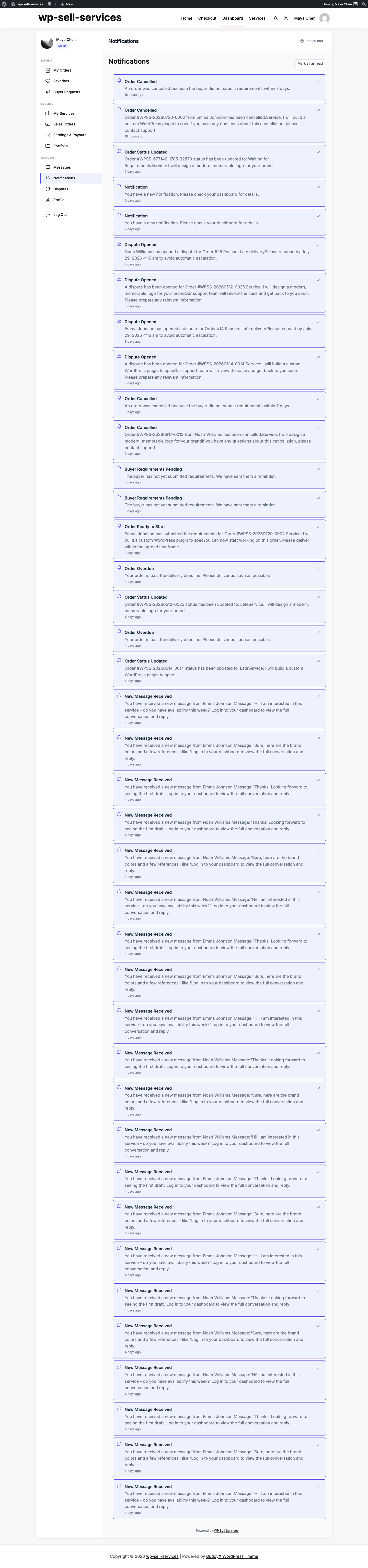
A notification bell appears in the dashboard with an unread count badge. When something happens -- a new order, a message, a delivery, a review -- a notification is created instantly. Users click the bell to see their alerts and navigate directly to the relevant page.
What Triggers Notifications
Notifications are created for all major marketplace events:
- New order placed
- Order status changes (in progress, delivered, completed, cancelled)
- New message received in an order conversation
- Delivery submitted by vendor
- Delivery accepted by buyer
- Revision requested by buyer
- Review received from a buyer
- Dispute opened or resolved
These in-app notifications are always created, regardless of whether email notifications are enabled or disabled. They are independent systems.
Viewing Notifications
From the dashboard, click the notification bell to see your notifications list. Each notification shows:
- An icon indicating the type of event
- A brief message describing what happened
- A relative timestamp (e.g., "2 minutes ago")
- A link to the relevant order, message, or page
You can filter to see only unread notifications or browse by notification type.
Managing Notifications
Mark as Read
Click on any notification or use the "Mark as Read" link to clear it from your unread count.
Mark All as Read
Click the Mark All as Read button at the top of the notification list to clear all unread notifications at once.
Automatic Cleanup
Read notifications are automatically deleted after 90 days to keep things tidy. Unread notifications are kept until you read or dismiss them. Important notifications (disputes, order completions) are preserved longer.
The Unread Badge
The notification bell shows a number badge indicating how many unread notifications you have. This count updates as new events occur and decreases as you read or dismiss notifications.
Notifications vs. Email
In-app notifications and email notifications work independently:
| Feature | In-App | |
|---|---|---|
| Always created | Yes | Only if admin enables the type |
| Requires login to see | Yes | No -- delivered to inbox |
| Can be marked as read | Yes | No |
| Stored in dashboard | Yes | No -- lives in email inbox |
| Links directly to relevant page | Yes | Yes |
Disabling an email notification type does not affect in-app notifications. Users will still see the alert in their dashboard.
Push Notifications to Phones [PRO]
A member with your mobile app installed can be notified on their phone for the same events they already receive in the app. Nothing new to decide about what gets sent - push follows the notifications you already have.
Off by default, and it needs credentials before it will send anything.
Setting it up
- Create a Firebase project at console.firebase.google.com and generate a service account key - a JSON file Google gives you once.
- Go to Sell Services > Settings > Advanced.
- Paste the JSON into the push notification credentials field and enable it.
- Save.
Firebase relays to Apple's service for iOS, so one credential covers Android, iOS and web. You do not need a separate Apple key.
What to expect
- A member's device registers itself when they sign in on the app. Nothing for them to configure.
- A device that uninstalls the app or rotates its token is dropped automatically, so you are not paying for delivery attempts to phones that no longer exist.
- The credential is stored masked. Re-saving settings without retyping it keeps the existing one rather than blanking it.
Before you rely on it
Push has been verified as far as the request this plugin sends. What Google does with a valid-looking request has not been tested against a real handset. Send yourself a test on a real phone before telling members the feature exists.
Tips
- Check notifications regularly. The dashboard bell is the quickest way to stay on top of orders, messages, and reviews.
- Use email for time-sensitive items. If you need to respond quickly (like a new order or message), make sure those email types are enabled so vendors and buyers get immediate alerts.
- Do not ignore the unread badge. A growing badge count usually means there are actions that need your attention.